Hudbay lifts Snow Lake gold output estimate by 60%
Longer mine life and stronger recoveries position the Manitoba operation to generate steady free cash flow through 2043.
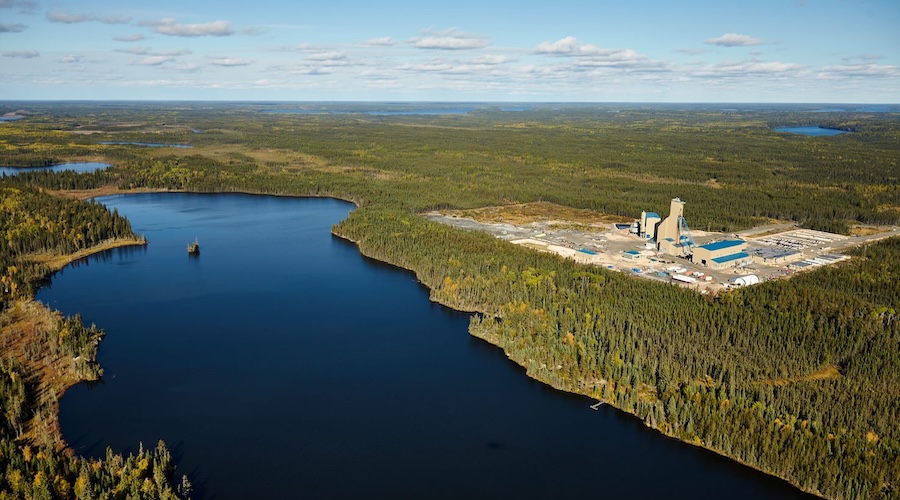
Snow Lake operations in Manitoba, Canada. (Image courtesy Hudbay Minerals.)
Hudbay Minerals (TSX, NYSE: HBM) has increased forecast life-of-mine gold production at its Snow Lake operations in Manitoba, Canada, by about 60% to 2.8 million ounces under an enhanced mine plan.
The new forecast compares with 1.8 million oz in Hudbay’s 2021 technical report, while higher proven and probable reserves extend the operation’s mine life by two years to 2043.
Hudbay expects Snow Lake to produce an average of 185,000 oz. of gold annually from 2026 through 2030, supported by strong throughput at the New Britannia mill and higher recoveries at the Stall operation.
The updated plan represents a 37% increase in production over the five-year period, adding about 250,000 oz. compared with the previous plan.
“The strong margins and steady gold production will ensure Snow Lake continues to be a meaningful free cash flow contributor and provide complementary gold exposure for Hudbay,” CEO Peter Kukielski said.
Jefferies analysts said in a note the improvement was being achieved largely through higher mining rates, better mill utilization and improved recoveries rather than a major expansion project.
The expanded plan reinforces Snow Lake’s transformation from a zinc-focused operation into a significant source of gold for Hudbay, providing diversification as the company advances its copper growth pipeline.
Stronger margins
Hudbay forecasts average gold cash costs of $821 per oz. from 2026 through 2030, with sustaining cash costs averaging $1,379 per oz. over the same period.
The company says those costs should allow Snow Lake to maintain strong operating margins while contributing free cash flow to support its broader portfolio.
Jefferies noted that costs are moving higher but said Snow Lake remains positioned to generate meaningful cash flow at current gold prices. The bank sees a particularly significant improvement from 2031 through 2035, when Hudbay now forecasts average annual production of about 126,000 oz., compared with Jefferies’ previous estimate of roughly 32,000 oz.
New Britannia is expected to play an important role in supporting the production profile. Jefferies said the mill is operating above 2,000 tonnes per day, while Hudbay’s plan assumes throughput rises to 2,300 tonnes per day beginning in 2027. That remains below New Britannia’s permitted capacity of 2,500 tonnes per day, suggesting further upside could come from future debottlenecking, according to the bank.
“Transitioning this operation from a zinc-rich operation to a leading Canadian gold operation over the last five years has been transformative for Hudbay and we look forward to sustainable production in the decades ahead,” Kukielski said.
Comments
No comments yet.